 |
| Fundamentals of Public Relations |
Fundamentals
of Public Relations MCM 401
VU
Lesson
17
ROLE
OF PUBLIC RELATIONS IN
MARKETING
Overview
This
lecture will explain various
functions and roles of
public relations in marketing and how
does it
provide
support in this effort. The students
will also be apprised of the
role of public relations in
market
education,
besides providing a guide
line in relation to the market
mix and for devising an
effective market
education
strategy.
Public
Relations has become a very
important profession as it provides the desired
support as and when
needed
for the implementation of various
programs including marketing. In fact marketing
now a days
primarily
depends upon the support provided by the
public relations department .The major components
of
the
support provided by PR in marketing are
enumerated below:
1.
Publicizing
news & events.
2.
Promoting
established products or services.
3.
Creating
a favorable reputation of the
company.
4.
Arranging
& publicizing public appearance of
marketing spokespersons.
5.
Probing
public opinion.
(research)
6.
Attracting
news media coverage of sales
conferences, trade shows &other
sales promotion
events.
7.
Assisting
in programs concerning
consumerism.
8.
The
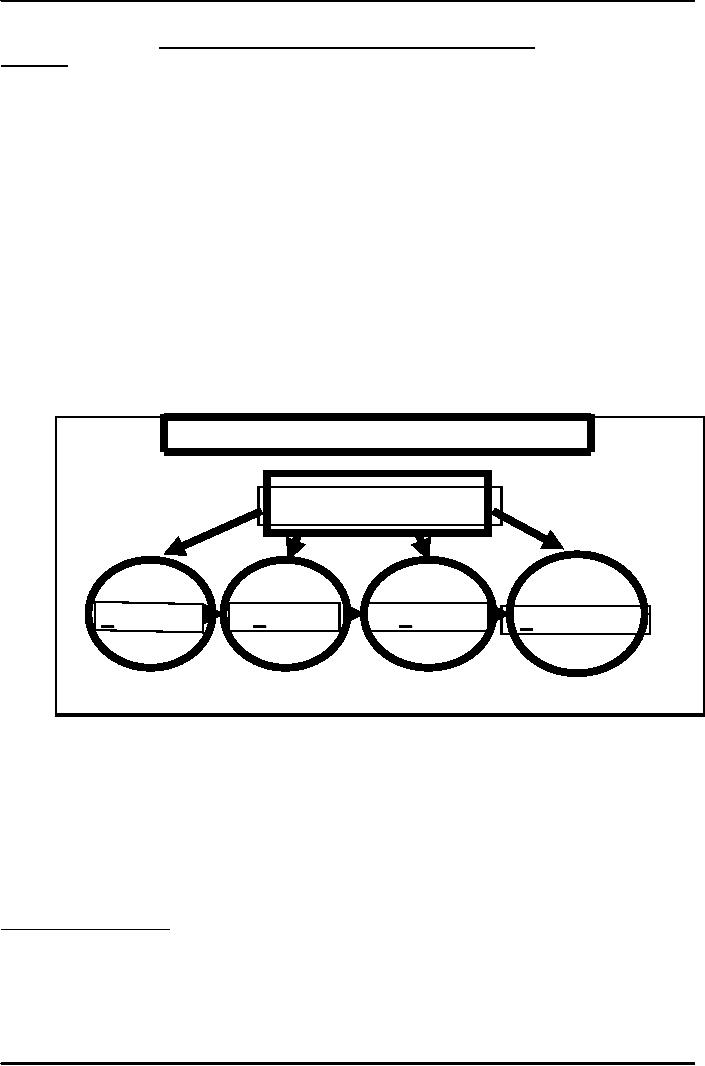
following figure will
explain the role of PR in marketing by
using four P's signifying
different
segments
of
this
role.
4
P's to PR Role in marketing.
Public
Relations
PRODUCT
PLACE
PRICE
PROMOTION
The
basic purpose of dividing the
role in four "P's" as illustrated in
above figure is to explain the scope
in
which
PR provides support to marketing.
·
The
first
"P" denotes
Product meaning thereby the PR determines the
features by
ascertaining
its quality and
standard.
·
The
second
"P" pertains
to the place of origin and the
territory of marketing.
·
The
third
"P" determines
the price keeping in mind the
market trend, acceptability
and
the
prevalent competition. and
;
·
The
fourth
"P" ascertains
the role in the promotion of the
product.
PR
And Marketing
Mix.
1.
Conception, innovation or modification of
new product.
2.
The place of the product in
product life cycle.
3.
Marketing research.
4.
Naming & Branding.
5.
Product image.
6.
Market segment.
44

Fundamentals
of Public Relations MCM 401
VU
7.
Pricing.
8.
Product
mix, rationalization &
standardization.
9.
Packaging.
10.
Distribution.
11.
Sales
force.
12.
Market
education.
13.
Corporate
& financial public relations.
14.
Test
marketing.
15.
Advertising.
16.
Industrial
relations.
17.
Advertising
research.
18.
Sales
promotion.
19.
The
after market; after sales service,
spares, guarantees, instructions.
20.
Maintaining
customer interest &
loyalty.
Public
Relations & Market
Education
3
Fold Effect Of Market Education In
Advertising.
1.
Will help to make advertising
more quickly acceptable &
productive in response.
2.
Could make less weighty advertising
possible.
3.
Whatever advertising is conducted, it is
likely to be more
economical.
--
Thus overall marketing expenses could be
reduced if more was spent on
Public Relations.
How
To Educate The Market
2
Kinds of Market Education
One
kind
of market education prepares the
market in advance... Also
called pre-selling.
Second
kind
of marketing education occurs with
products & services that
are already on the
market.
2
Types of Market
1st
type of market: The
people who sell your products or
service --- Trade.
2nd
type of market:
The
people who buy or use your products
---
Consumers or users.
Effects
Of Adopting Market Education
Strategy.
1.
It helps to minimize sales
resistance.
2.
Easier for the sales force to
achieve `adequate distribution'
prior to advertising.
3.
It helps to reduce the cost of
advertising.
4.
It makes advertising more
effective.
Techniques
Adopted For Market
Education.
1.
A media relations campaign in press,
radio and TV.
2.
Testing of prototype by potential
users often providing
material for media
relations.
3.
Production of slides, videos &
other audio & visual aids
for use at dealers,
customers conventions
etc.
4.
Work visits for
dealers.
5.
Special campaigns aimed at particular
opinion leaders or influential
groups.
6.
The production of printed
material which may be needed
to support these
activities.
45
- INTRODUCTION & BRIEF HISTORY:Definitions Of Public Relations
- HOW DOES PR WORK?:OVERVIEW, Formulation of policy
- PUBLIC RELATIONS DISTINGUISHED:Size of a PR Department.
- PUBLICS OF PR:Expanded Publics, Few Examples Of Publics
- PLANNING PUBLIC RELATIONS PROGRAMMES:Print Media, Electronic Media
- MEDIAS OF PR:Media for External Publics, Principles of Good Press Relations
- PRESS RELATIONS IN PR:What is News, Secrets Of Good News Release.
- CREATED PRIVATE MEDIA:Private Media, New Forms of House Journals
- SPECIAL USES OF PUBLIC RELATIONS:Crisis Management, Skills Of PR
- BUDGETING IN PR:Labour, Office Overheads, PR & Photographs
- PUBLIC RELATIONS PROBLEMS:Defining PR problems, C’s of PR explained
- METHODS OF COMMUNICATION:Psychology of Public Relations
- PR IN VARIOUS ORGANIZATIONS:Techniques of Trade Association PR
- PR IN LABOUR UNIONS & RELIGIOUS GROUPS:Community Public Relations
- PR IN EDUCATIONAL INSTITUTIONS & IN MEDIA CHANNALS
- USING ADVERTISING FOR P R COMMUNICATION:Role Of PR
- ROLE OF PUBLIC RELATIONS IN MARKETING:How To Educate The Market
- PUBLIC RELATIONS AND CORPORATE STRUCTURE:Corporate Identity Essentials
- E-PR & ITS TOOLS:Immediate Points To Consider, Using Email As PR Tool
- SPONSORSHIP—AN IMPORTANT PR TOOL:PR & Communication Audit
- HOUSE JOURNALS:Possible Publics Of House Journals, Exhibitions & PR
- CRISIS MANAGEMENT IN PR:Plan Of Action Adopted, Interview at your place
- ADVERTISING IN PR:Broad Objectives Of Advertising, Direct Advertising.
- INTERNATIONAL PUBLIC RELATIONS:Media Used, Within Store Contacts
- PUBLIC RELATIONS CONSULTANCY:Disadvantages, Mass Communication
- PUBLIC RELATION’S ROLE IN MARKET EDUCATION:Kinds Of Markets
- MODERN DAY VALUES OF PR:Ethics Of Public Relations
- CHOICE OF MEDIA FOR PR COMPAIGN:Communication Channels & Media
- PR TECHNIQUES:Tactics & Techniques
- DESIGNING PR COMPAIGNS:Definitive Mission statement, Reputation.
- PUBLIC OPINION:Identifying Priority Publics, If Goal Is Attitude Change
- PUBLIC RELATIONS AND RESEARCH:Planning Phase Of Research
- PR AND RESEARCH:Unobtrusive Measures, Questionnaires For Survey
- PROBLEMS SOLVING STRATEGIES:Communicate results
- PERSUASION & COMMUNICATION THEORIES:Message Orientation
- COMMUNICATION CONCEPTS & THEORIES:Research and Persuasion
- PUBLIC RELATIONS & LAW:How To Stay Out Of Trouble
- PUBLIC RELATIONS & CASE STUDIES:Case Analysis, Images Of Public Relations
- PR AND PRINTING PROCESSES:Fundamentals Of Printing
- PUBLIC SPEAKING -- A PR TOOL:Key Benefits, How To Prepare
- PR -- COPING WITH UNEXPECTED:Some Possible PR Ideas
- DREAMS & REALITIES OF PR:Who Takes Charge Of Identity?
- CHANGING INTO OVERDRIVE:How International Is PR?
- GETTING ON WITH PR:Where does PR fit in the structure?
- FUNDAMENTALS OF A SUCCESSFUL NEWSLETTER:RESEARCH, WRITING